

Outdoor Group Cold Plunges (Ice Baths) – Safety Guidelines for Early-Year Conditions
- Apr 7
- 3 min read
The beginning of the year often marks a fresh start. For many, this is the time when they step into cold water to welcome the new year – including those who don’t regularly practice cold exposure throughout the rest of the year. This is completely understandable.Cold carries a powerful symbolism – clarity, renewal, and the invitation to step beyond your limits. At the same time, outdoor group cold plunges require a deeper level of awareness to be practiced safely.
It is important to recognize that outdoor cold exposure is the most intense way of experiencing cold.It is not the same as a cold shower indoors or a plunge in a controlled environment at home. Natural conditions are inherently unpredictable.This is exactly why they require adaptation, gradual exposure, and a critical level of awareness. If you would like to understand more deeply how your nervous system responds to cold and stress, you can read more about it here.
This topic is especially relevant at this time of year.It is not about discouragement, but about responsibility. Cold becomes a truly supportive experience when it is approached within the right framework.
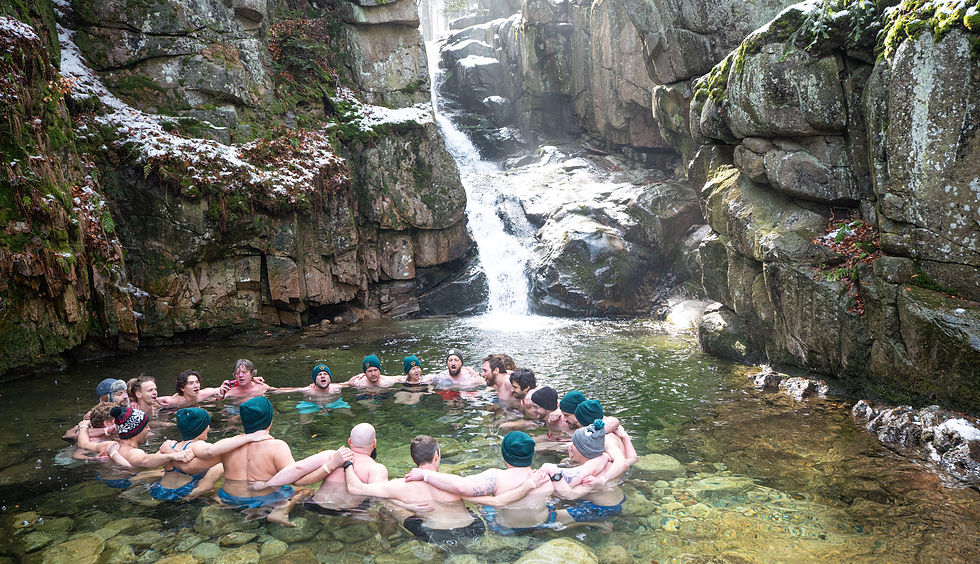
What True Safety Means in Outdoor Group Cold Plunges
1.How Breath and Cold Exposure Interact – and Why Timing Matters
In group settings, intense breathing often appears just before entering the water. However, this can carry significant risk. Breathing directly affects the balance of oxygen and carbon dioxide in the body, while cold immediately triggers a stress response.
When combined without proper timing, these two can easily overwhelm the system. Cold water is not a performance task, but a stimulus for the nervous system. It is worth entering the water from a clear, settled state, and never immediately after practicing an intense breathing technique. Breath, cold, and focus work together in shaping your nervous system – you can read more here about how this system is structured within a guided process.
2. A Fixed Time Frame Creates a False Sense of Safety
“We will stay in for this many minutes” – this is often said, yet it can be misleading. Cold adaptation is not a collective process. What still feels comfortable for one person may already be too much for another.
Safety begins when we stop following the clock and start responding to the signals of the body.
3. When Attention Turns Outward
Conversation, laughter, encouraging each other – these create connection on a group level, yet in cold water they can easily draw attention away from the body’s subtle signals.
In the cold, it is precisely these signals that show when it is enough, when it is time to step out. True presence is often quiet.
4. Without Gradual Exposure, There Is No Solid Foundation
For beginners, longer or repeated outdoor cold plunges raise important questions around the principle of gradual exposure. Adapting to cold is a process, not a jump. When this layer is missing, the experience does not deepen, and can instead become overwhelming for the body. If you would like to experience this process within safe, guided conditions, a workshop setting allows this experience to build step by step.
5. Who Is Paying Attention When Support Is Needed?
In group cold plunges, a key question arises: if the group leader is also in the water, who is there outside, with a clear mind, able to respond immediately? Safety is not an assumption, but a presence that is planned in advance.
6. Physical Warm-Up and Afterdrop Management – An Essential Element
Before and after meeting the cold, physical warm-up is essential. Movement, muscle activation, and the gradual generation of heat.
A sauna or a hot tub is not the solution in this phase. Rapid external heat can disrupt the body’s natural rewarming process. It is the body’s own heat production that creates a stable foundation – and this can be supported through movement and conscious presence.
Why Is It Important to Talk About This?
Because cold is not an enemy, but a powerful teacher. And every encounter with a teacher becomes truly supportive when it is held within a clear framework. Responsibility does not take away from the experience – it makes it safe.
If you are joining an outdoor group cold plunge, it is worth taking these safety considerations into account. To ask questions. To stay attentive. And to step into a space where guidance is just as present as the cold itself.
Your body is always communicating. The question is whether there is space to listen.
If you would like to experience this connection to your own body, this process truly begins within a guided space.
