

Cold Exposure Duration – Why Your Nervous System Matters More Than Time
- Apr 7
- 3 min read
“How long should I stay in the cold water?”
This is one of the most common questions I encounter when people practice the Wim Hof Method – in workshops, retreats, and one-on-one conversations.
It is completely understandable. Time is measurable. Tangible. Comparable. It offers a sense of reference in an environment that can feel unpredictable at first. Yet the true safety and effectiveness of cold exposure are guided by something else: the body’s current responses. If you would like to understand more deeply how this nervous system response works, you can read more about it here.
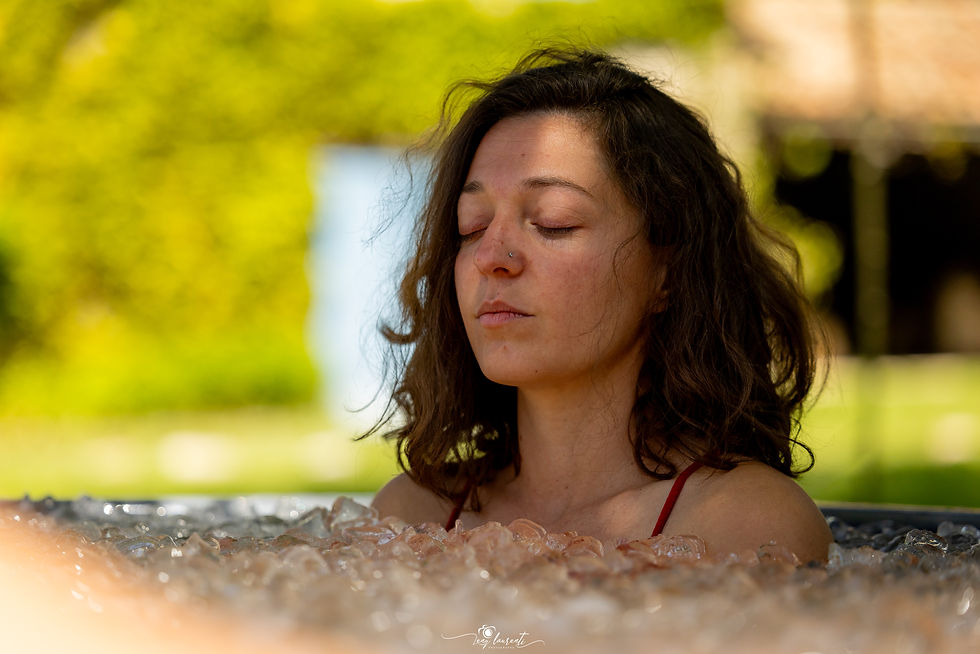
Cold as a Hormetic Stressor – Conscious Training for the Nervous System
Cold exposure works through the principle of hormetic stress. This means that the body is exposed, for a short and intentional period, to a more intense stimulus, and through adapting to it, the regulatory systems become stronger – the nervous system, the immune system, and hormonal balance.
Progress is determined by the level of load the system receives on a given day, and how well this aligns with the body’s capacity to recover.
The “dose” of cold is therefore unique every time:
it depends on the quality of your sleep,
the level of mental and emotional load,
the state of your digestion,
your current energy level,
your inner focus and presence.
For this reason, even on two consecutive days, the duration that supports adaptation can be completely different.
Why Time Alone Can Be Misleading?
Many people evaluate their practice based on time, drawing conclusions about progress, “results,” and their own performance.
The body, however, functions as a cyclical, ever-changing, and sensitive system. In cold adaptation, each person arrives with a different nervous system pattern, and even within the same individual, the optimal level of load can shift from day to day.
True adaptation therefore does not organize itself around a fixed number, but around an ongoing dialogue with the body.
The Dose of Cold Unfolds Within a Process
Cold exposure does not begin when you step into the water, and it does not end when you step out.
We are speaking about a complete process that includes mental preparation, the quality of your breathing, your presence in the water, the rewarming phase after you step out, and how you feel even hours later.
Together, these form the true “dose.” Breath, cold, and focus create the foundation of this system – you can read more here about how this is structured in practice.
When Time Takes Over
When only the minutes matter, attention inevitably shifts outward. The body’s signals become quieter, the nervous system can become more tense, and the practice loses the quality through which it can truly become supportive.
In these moments, experiences may arise that many people mistakenly attribute to the cold itself: prolonged fatigue, getting sick, urinary discomfort, exhaustion. In reality, these are almost always signs that the dose of cold did not match the body’s capacity on that particular day.
Progress Emerges Through the Fine-Tuning of Regulation
One of the most valuable outcomes of cold adaptation is the strengthening of nervous system self-regulation.
This often appears as a quiet shift:
a faster return to calm after stress,
more precise sensing of boundaries,
earlier recognition before overload,
a more stable sense of inner presence.
This kind of progress is rarely dramatic. Yet it is deep and lasting.
A Reflective Question for Your Practice
The next time the question arises in you, “How long should I stay in the cold?”, it is worth placing this alongside it: “What is the dose of cold that best supports my system today?”
The answer appears in the rhythm of your breath, in the tone of your muscles, in the quality of inner stillness or tension.
This is the kind of feedback that, over time, shapes not only strength but also awareness. If you would like to experience this in practice, this process becomes truly clear within a guided setting.
